

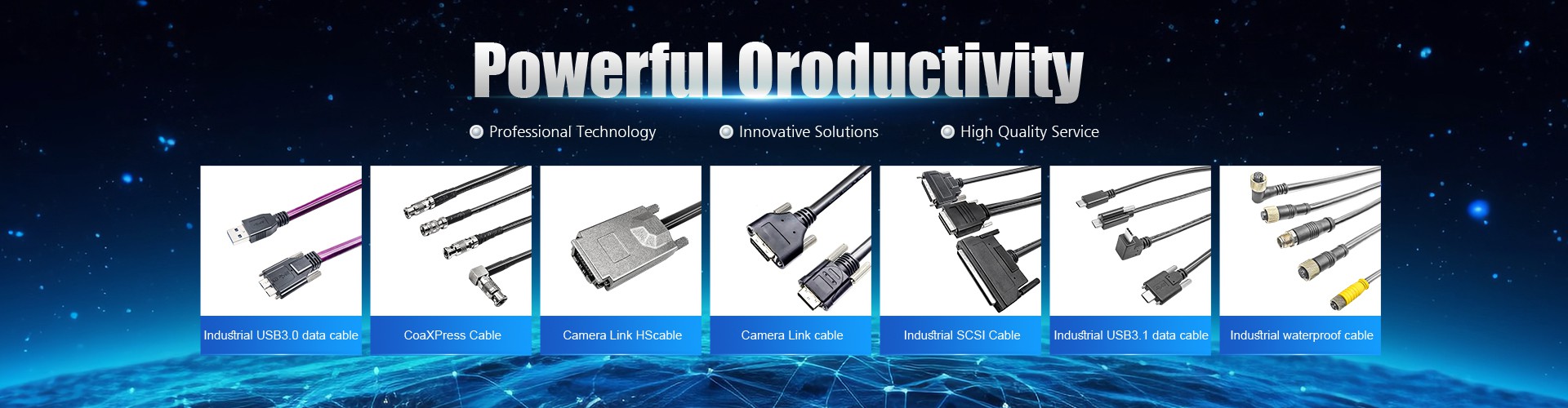
High-Frequency Vision Cables for Machine Vision & Industrial Imaging- Engineered for zero-frame-loss transmission in high-speed
Karobert manufactures high-frequency vision cables for machine vision, industrial imaging, inspection equipment and other applications where stable high-speed signal transmission is essential.
Unlike a conventional cable that mainly needs to provide electrical continuity, a high-frequency vision cable must maintain controlled electrical characteristics as the signal travels from the camera to the processing or acquisition system. Cable impedance, conductor geometry, dielectric structure, shielding, connector transition and cable length can all affect signal quality.
Our cable assemblies can be configured for different high-speed interfaces and application requirements, with options for cable construction, connector type, length, shielding and mechanical design.
-
![HDMI Cable]() HDMI CableIn the realms of high-performance computing, professional content creation, and advanced visualization, the DisplayPort interface has become the preferred choice for connecting high-end graphics
-
![HDMI Cable]() HDMI CableIn modern industrial environments, from precision instrument panels in control rooms and visual inspection interfaces on automated production lines to large screens in digital signage and command
-
![DVI Cable]()
-
![High-frequency Visual Line]() High-frequency Visual LineAs machine vision technology rapidly advances toward higher resolution, faster frame rates, and smarter analysis, traditional transmission interfaces are increasingly hitting bandwidth and distance


CoaXPress (CXP) Cable Assemblies
• Protocol Support: CXP-1 through CXP-12 (Up to 12.5 Gbps per coax line)
• Impedance: 75 Ohm (+/- 2 Ohm tolerance control)
• Key Feature: Integrated Power-over-Coax (PoC) with high-density Micro-BNC / DIN 1.0/2.3 connectors
• Typical Application: High-resolution area and line-scan cameras (e.g., Basler, Hikrobot, Dahua, FLIR)
Camera Link (CL) Cable Assemblies
• Configuration: Base, Medium, Full, and Deca configurations
• Shielding: Individual twisted-pair foil shield plus overall tinned copper braid
• Connectors: SDR (Mini Camera Link), MDR 26-pin, with thumb-screws or latching mechanisms
• Flex Life: High-flex options rated for >10 million drag-chain cycles
Camera Link HS (CLHS) Cable Assemblies
• Transmission Rate: Up to 10 Gbps (CX4 / SFP+ fiber or copper implementations)
• Design: Low-skew differential pair construction for deterministic real-time triggering
• Application: Next-generation ultra-high-speed inspection (Semiconductor, PCB, FPD)
Custom & Legacy Vision Cables
USB3 Vision, GigE Vision (Cat6a/Cat7 high-flex), and hybrid power/IO cables
Cross-reference alternatives available for 3M, Intercon 1, and Honda Connectors
Technical Specifications
|
Parameter |
Specification Detail |
|
Interface Protocols |
CoaXPress 1.x/2.0, Camera Link (Base/Med/Full), Camera Link HS, GigE Vision |
|
Characteristic Impedance |
75 Ohm (Coax), 100 Ohm (Differential Pairs) |
|
Data Rates |
Up to 12.5 Gbps per lane |
|
Conductor Material |
Silver-plated copper / Tinned oxygen-free copper |
|
Jacket Materials |
High-flex TPU / Oil-resistant TPE / Flame-retardant PVC (UL20276) |
|
Flex Rating |
Static: 5x OD / Drag-chain: >10 million cycles at 7.5x OD |
|
Operating Temperature |
Static: -40 deg C to +80 deg C / Dynamic: -20 deg C to +70 deg C |
|
Certifications |
RoHS, REACH, CE, UL Style Compliant |
|
Compatible Brands |
Basler, Hikrobot, Dahua, Teledyne DALSA, FLIR, Matrox, Euresys |
• Connector Orientation: Straight, Right-Angle (Up/Down/Left/Right), custom backshells.
• Installation Class: Static wiring or continuous drag-chain motion (minimum bend radius down to 7.5x OD).
• Cable Jacket Options: Flame-retardant PVC, TPE, or high-abrasion/oil-resistant TPU.
• Labeling & Packaging: Custom laser marking, barcode generation, and private-label retail packaging.
OEM Project Workflow
• Step 01: Requirement Review (Interface, length, motion profile, pinout)
• Step 02: Drawing & Specification Approval (24-hour turnaround)
• Step 03: Prototype / Sample Build (3 to 5 business days)
• Step 04: Laboratory Signal Verification (S-parameter & TDR analysis)
• Step 05: Mass Production & 100% End-of-Line Testing

Technical Performance & Engineering Standards
Unlike general signal wiring, high-speed vision cables function as active transmission lines. We control every parameter to maintain signal margin across long distances.
Controlled Impedance Continuity
Impedance mismatches cause signal reflections, resulting in frame dropouts. We maintain tight impedance tolerances (+/- 2 to +/- 5 Ohm depending on protocol) from the raw conductor through to the soldered/crimped connector junction.
Frequency-Dependent Insertion Loss Data
We do not rely on vague "low loss" marketing claims. Every cable batch is validated with Keysight Vector Network Analyzers (VNA) to provide frequency-dependent S-parameter insertion loss graphs up to 12.5 GHz.

Operating next to servo motors and VFDs requires robust isolation. Our multi-layer shielding uses:
Inner Layer: 100% coverage Aluminum/Mylar foil for high-frequency noise attenuation.
Outer Layer: High-density (up to 95%) tinned copper braid for low-frequency magnetic isolation and ground continuity.
Quality Assurance & Signal Integrity Testing
Visual and simple continuity checks are insufficient for Gbps vision systems. Karobert enforces a two-tier quality control protocol:
Standard Factory Inspection (100% of Production):
• Pin-to-pin continuity
• Open / Short / Miswire testing
• Insulation resistance (DC 300V)
• Hi-pot voltage testing
High-Frequency Signal Integrity Testing (Sample Batch / On-Demand):
• Time Domain Reflectometry (TDR) for impedance profile mapping
• Attenuation / Insertion Loss measurement
• Return Loss / Crosstalk verification
FAQ
We're known as one of the most professional high-frequency visual line manufacturers and suppliers in China, also support customized service. Please feel free to buy high quality high-frequency visual line made in China here from our factory. For price consultation, contact us.
high frequency visual line, DVI Cable, HDMI Cable


